Updated
April 30, 2025
FUSE PAGE, the good, the bad, and the dangerous (1st image!)
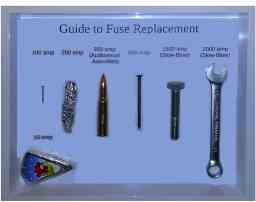
Here is my attempt to help people choose between various fuses that are offered and aid in identifying them by appearance:
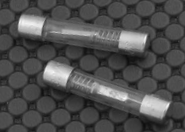
The MDQ (That is MDQ, not MDL) is a "Dual-Element" fuse - it has a coil spring connected to a
lump of metal and from the other end of the metal a wire that goes to
the other end cap, this will sustain over currents of 200% for a maximum
of 120 seconds for all fuse values (no minimum time given), it will hold 100% forever,
and 135% for 60 minutes maximum. (MDQ - PDF)
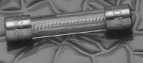
The MDL is a coil of wire wrapped around a core and it shares the same
characteristics: 200% for a max of 120 seconds (min time from 3 to 5 seconds), 135% for max of 60
minutes and 100% forever, however for values between 1/16 through 3A @
200% it will hold for a minimum of 5 seconds, and for values from 3-2/10
through 8A it will hold for a minimum of 12 seconds at 200%. (MDL - PDF)
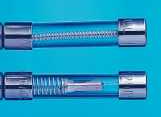
There is also a fuse series GDL by Ferraz-Shawmut that uses both styles of elements above (MDQ & MDL) depending on the current and voltage ratings (GDL - PDF)
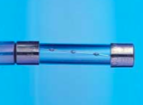
Next there is a time delay fuse - ATE (Ferraz-Shawmut) (might be the T(amperage)AL series as well) - that is a glass fuse with metal end caps and the fuse element is a wire with up to 3 blobs/dots of metal (solder? lead?) on it to enable the delay action. Its characteristics: 200% for a min of 2 seconds or a max of 120 seconds, 135% for max of 60
minutes and 100% only 4 hours. If the fuse has pigtail wires then it is the ATP-A (F-S). (ATE - PDF)
The charts on both the MDL & MDQ fuses show that for an MDL 1A fuse it will blow
in 1 second @ 4.5A, a MDQ 1A fuse will blow in 1 second @ 6A. However
for both fuse types a 6-1/4A fuse will blow in 1 second at about 40A and
in 10 seconds @ 17.5A
So the ATE, GDL. MDL, and MDQ are interchangable in our applications (jukeboxes/pinball games), with slight
preference to the MDL fuse as it blows a bit faster in the lower values...
Note also that Fast Blow fuses (AGC)will also hold forever @ 100%, 60 minutes max
@ 135% and 200 seconds max @ 200%, however their surge charateristics are far shorter than the slo-blow/time delay fuse. (AGC- PDF).
Dimensions:
AGC, GDL, 3AG, MDL, MDQ - 31.75mm (+/- 0.75mm) X 6.35mm (+/- 0.1mm) or 1.250 x 0.250 inches.
Definitions:
AGC = Automotive Glass Cartridge fuse
...
Here is a PDF of BUSSMAN fuses as sold in 1968 by Electrosonic in Toronto (city hall pictures done by my father's - G. Hugh Robertson - company PANDA ASSOCIATES.) More BUSSMAN fuse pages in the 1970s from a company called R-A-E (RAE) Industrial Electronics (defunct? was part of/associate of Cardinal Industrial Electronics (bought out by Arrow) in Edmonton) located in Vancouver, BC
And if you want to know more about fuses then go here!
And if you really want a lot of useful information about fuses from somewhere near the late 50s then you can't go wrong downloading this BUSSMAN Fuse catalog (21mb) (what the Electrosonic page above was based on).Pages of explanation about what each type of cartridge fuse was including charts showing how fast they blow under various situations...
Lamp Load for testing equipment
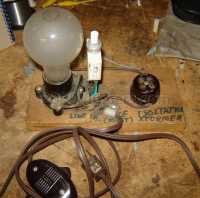
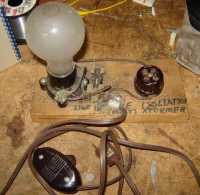
For the service person who wants to test something without blowing fuses I suggest you use the Lamp Test Fixture as shown below. Simply put, it is a 25 to 100W light bulb (depending on expected load) in series with a power switch (optional) and your load (line voltage being 100VAC/120VAC/220VAC/240VAC - depends on where you live). If you can't figure it out, then you shouldn't attempt building it!
Next -how can you do some service work without going through a fortune in fuses? Finding intermittent faults that take out fuses when youa re somewhere else in the shop can be a pain to catch...The point of a light bulb across the breaker/fuse is the light turns ON when the breaker pops and this is very handy when you are elsewhere in the shop and the fuse is on an intermittent circuit. When you see the light you know the problem has returned and you can deal with it while it is 'hot'. Probe with IR detector, camera, etc...
Please(!) for personal safety use an ISOLATION TRANSFORMER to protect yourself from the risk of electrical shock - or a Ground Fault sensing outlet.
John :-#)#
|
 Flippers.com
 Click here to order Parts